For more than three decades, Northern Ireland was the scene of a violent conflict known as the Troubles. Bombings, shootings, assassinations, riots, imprisonment, and military operations became part of everyday life. More than 3,500 people were killed, and tens of thousands were injured.
The conflict is often described simply as a war between Roman Catholics and Protestants. There is some truth in that description, but it is also misleading.
Religion mattered enormously. Religious identity helped define communities, political loyalties, historical memories, and fears. Yet the Troubles were not primarily a theological dispute over Catholic doctrines versus Protestant doctrines.
No one was fighting over justification by faith, papal infallibility, baptism, or the number of sacraments.
At its heart, the Troubles were a conflict over national identity, political power, territory, constitutional status, civil rights, and competing visions of the future of Northern Ireland.
Religion was both more and less important than it first appears.
It was not usually the direct cause of political violence.
But it provided the language, symbols, boundaries, memories, and identities through which much of the conflict was experienced.
A Conflict with Deep Historical Roots
The roots of the Troubles stretch back centuries.
Ireland had long been a predominantly Catholic country. English and later British control of Ireland, however, brought major political and religious changes.
The Protestant Reformation created a widening divide between England and Ireland. England became predominantly Protestant, while most of Ireland remained Roman Catholic.
The situation changed dramatically during the Plantation of Ulster in the seventeenth century.
Protestant settlers from England and Scotland were encouraged to settle in Ulster, particularly in land taken from Irish Catholic landowners.
Over time, northern Ireland developed a distinctive population.
Many Protestants identified strongly with Britain.
Many Catholics retained a stronger Irish identity.
The conflict was therefore not merely religious.
It was also ethnic, cultural, political, and territorial.
Two communities increasingly occupied the same territory while imagining very different futures for it.
The Partition of Ireland
The immediate political background to the Troubles was the partition of Ireland.
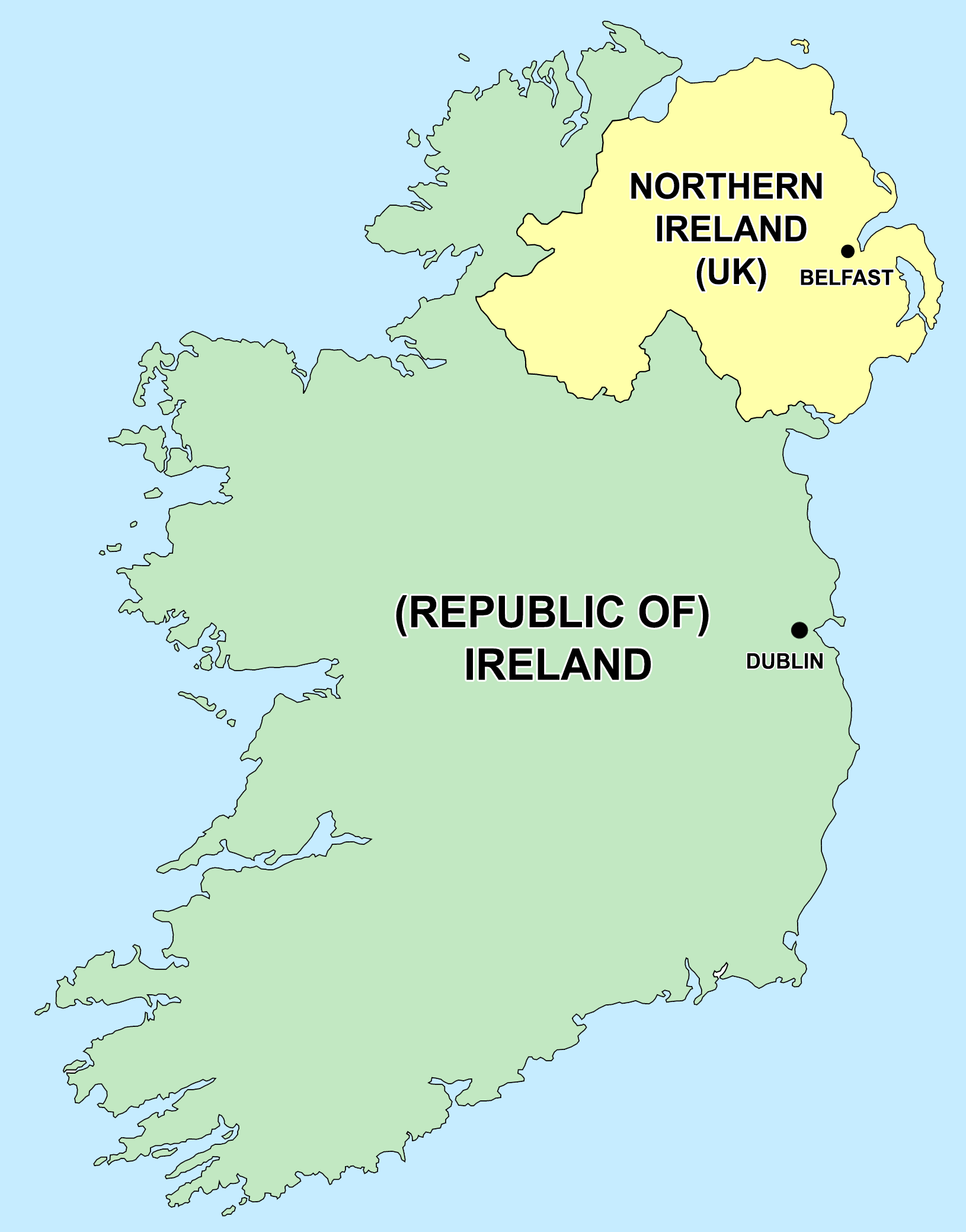
In 1921, following the Irish War of Independence, Ireland was divided.
Most of the island eventually became the Irish Free State and later the Republic of Ireland.
But six counties in the northeast remained part of the United Kingdom.
This became Northern Ireland.
Northern Ireland had a Protestant and unionist majority.
Most Protestants wanted Northern Ireland to remain part of the United Kingdom.
They were known as unionists or loyalists.
The Catholic minority was more likely to identify as Irish and to support the eventual reunification of Ireland.
They were generally known as nationalists or republicans.
This distinction is essential.
Unionist and Loyalist
Generally:
- Wanted Northern Ireland to remain part of the United Kingdom.
- Identified strongly with Britain.
- Were predominantly Protestant.
Nationalist and Republican
Generally:
- Wanted Northern Ireland to leave the United Kingdom.
- Supported a united Ireland.
- Identified strongly as Irish.
- Were predominantly Roman Catholic.
These categories were not perfectly identical.
Not every Protestant was a unionist.
Not every Catholic was a nationalist.
But the religious and political identities overlapped heavily.
This was one reason the conflict appeared to be religious even when its immediate political issues were constitutional and territorial.
Northern Ireland Before the Troubles
From 1921 until the late 1960s, Northern Ireland was governed by a unionist-dominated political system.
Catholics and nationalists complained about discrimination in areas such as:
- Housing
- Employment
- Voting
- Local government
- Policing
The Protestant-dominated government argued that Northern Ireland faced a continuing threat from Irish republicanism.
Catholic civil rights activists argued that the system treated Catholics as second-class citizens.
By the 1960s, these complaints had become increasingly organized.
Inspired partly by civil rights movements elsewhere, activists began demanding reform.
The Northern Ireland Civil Rights Association organized marches calling for equality.
These protests became a major turning point.
The movement was not initially an armed rebellion.
It was a civil rights campaign.
However, many unionists feared that civil rights demands were actually part of a broader republican strategy to undermine Northern Ireland and eventually unite it with the Republic of Ireland.
The Violence Begins
Tensions increased rapidly in 1968 and 1969.
Civil rights marches were sometimes met with police action and loyalist counter-protests.
Rioting broke out.
One of the most important episodes was the Battle of the Bogside in Derry in August 1969.
Serious violence also erupted in Belfast.
Catholic neighbourhoods were attacked, and Protestant and Catholic communities increasingly separated themselves physically.
In August 1969, the British Army was deployed to Northern Ireland.
Initially, some Catholics welcomed the soldiers as protection from loyalist violence.
That relationship would later change dramatically.
The arrival of the British Army did not end the crisis.
Instead, Northern Ireland entered a long period of escalating conflict.
The Rise of the IRA
Irish republicanism had a long history before the Troubles.
The Irish Republican Army, or IRA, had been associated with earlier struggles for Irish independence.
During the Troubles, republican paramilitary organizations argued that British rule in Northern Ireland was illegitimate.
The most important republican paramilitary group became the Provisional IRA, formed around 1969–1970.
The Provisional IRA believed that armed struggle was necessary to end British rule in Northern Ireland.
Its campaign targeted:
- British military personnel
- Police
- Government institutions
- Political targets
- Economic targets
However, IRA bombings and shootings also killed large numbers of civilians.
The republican movement argued that it was fighting British occupation.
Its opponents regarded it as a terrorist organization.
Both descriptions reflected the intensely contested political nature of the conflict.
Loyalist Paramilitaries
Republican violence was met by the growth and activity of loyalist paramilitary organizations.
Major loyalist groups included:
- The Ulster Volunteer Force (UVF)
- The Ulster Defence Association (UDA)
Loyalist paramilitaries claimed to be defending Northern Ireland’s place in the United Kingdom.
In practice, many of their victims were Catholic civilians.
Loyalist groups also killed republican paramilitaries and members of nationalist political organizations.
The conflict therefore involved several overlapping struggles:
- Republican paramilitaries against the British state.
- Loyalist paramilitaries against republicans.
- Loyalist paramilitaries against Catholic civilians.
- Republican paramilitaries against loyalist paramilitaries.
- Security forces against paramilitary organizations.
It was not a conventional war between two armies.
It was a complex insurgency and sectarian conflict.
The British Army and the Troubles
The British Army became one of the major participants in the conflict.
British soldiers were initially deployed to restore order.
However, the relationship between the Army and Catholic communities deteriorated.
Two events were particularly significant.
Internment
In 1971, the Northern Ireland government introduced internment without trial.
People suspected of involvement with paramilitary organizations could be imprisoned without normal judicial proceedings.
The policy disproportionately affected Catholics and nationalists.
Many republicans regarded internment as proof that the British state was acting against their community.
Internment became a powerful recruiting tool for the IRA.
Bloody Sunday
On 30 January 1972, British soldiers shot civil rights demonstrators in Derry.
Fourteen civilians died.
The event became known as Bloody Sunday.
Bloody Sunday was a disaster for British efforts to maintain support among the nationalist population.
It intensified anger and helped increase support for republican paramilitary organizations.
1972 became the deadliest year of the Troubles.
The violence increasingly developed into a sustained conflict involving the Provisional IRA, loyalist paramilitaries, and British security forces.
Was the Troubles a Religious War?
This is the most important question.
The answer is:
Yes and no.
It Was Not Primarily a Theological War
The Troubles were not comparable to the religious wars of the sixteenth and seventeenth centuries.
Catholics and Protestants were not primarily fighting over theological doctrines.
The main political question was:
Should Northern Ireland remain part of the United Kingdom or become part of a united Ireland?
That was a constitutional and national question.
The central political divide was:
- Unionism versus Irish nationalism
- British identity versus Irish identity
- The United Kingdom versus a united Ireland
Religion was closely associated with these identities.
But religious doctrine was usually not the immediate issue.
Religion as an Identity Marker
Religion nevertheless played a central role.
For many people in Northern Ireland, asking whether someone was Catholic or Protestant was not simply a question about church attendance.
It could indicate:
- Family background
- Community
- Schooling
- Political loyalties
- National identity
- Cultural traditions
A Protestant was statistically more likely to identify as British and unionist.
A Catholic was statistically more likely to identify as Irish and nationalist.
This meant religion became a form of communal identity.
Someone could be a secular Protestant and still be identified with the Protestant community.
Someone could be a non-practising Catholic and still be identified with the Catholic community.
In this sense, religion was often more like an ethnic or national marker than an expression of personal theological belief.
Sectarianism and Historical Memory
Religion also carried enormous historical weight.
Protestant unionists remembered:
- The Reformation
- The Williamite victory
- The Battle of the Boyne
- The Protestant defense of Ulster
- The fear of being absorbed into a Catholic-majority Ireland
Catholic nationalists remembered:
- English conquest
- Land confiscation
- The Penal Laws
- Partition
- Political discrimination
- The struggle for Irish independence
These historical memories were reinforced through parades, commemorations, churches, schools, murals, flags, and political speeches.
Religion gave the conflict a powerful emotional dimension.
The dispute over the future of Northern Ireland could therefore be experienced as a threat not simply to political power but to community survival.
Ian Paisley: Religion and Unionist Politics
No individual better illustrates the complicated relationship between religion and politics in Northern Ireland than Ian Paisley.
Paisley was a Protestant minister, politician, and one of the most influential figures in Northern Irish unionism.
He founded the Free Presbyterian Church of Ulster in 1951.
He later founded the Democratic Unionist Party (DUP) in 1971.
For Paisley, religion and politics were closely connected.
He was not merely a politician who happened to be Protestant.
He was a fundamentalist Protestant minister whose theological convictions shaped his political worldview. Scholarly work on Paisley emphasizes the importance of religious identity to his political appeal, even while his influence eventually extended beyond his religious base.
Paisley’s Anti-Catholicism
Paisley was famous for his fierce opposition to Roman Catholicism.
He believed that the Roman Catholic Church represented serious theological error.
He opposed:
- Ecumenism
- Catholic-Protestant cooperation
- Political concessions to Irish nationalism
- Attempts to reduce sectarian boundaries
Paisley also opposed liberal trends within Protestant churches.
He criticized Protestants who cooperated with Catholics or participated in ecumenical activities.
In his worldview, religious compromise and political compromise could appear closely connected.
Paisley believed that Northern Ireland’s Protestant and British identity was under constant threat.
That fear could be mobilized politically.
CAIN’s analysis of sectarianism in Northern Ireland describes how Paisley’s anti-Catholic theology became intertwined with militant unionist politics and resistance to reform.
Paisley and the Civil Rights Movement
Paisley became particularly influential during the civil rights crisis of the late 1960s.
He opposed the reforming unionist Prime Minister Terence O’Neill.
O’Neill attempted to reduce tensions and improve relationships between Catholics and Protestants.
Paisley saw these policies as dangerous concessions.
He also regarded the civil rights movement with deep suspicion.
Paisley argued that apparently peaceful reforms could weaken Northern Ireland’s union with Britain.
His opposition helped divide the unionist political establishment.
The hard-line politics associated with Paisley eventually contributed to the creation and growth of the DUP.
Did Ian Paisley Cause the Troubles?
This question requires care.
It would be inaccurate to claim that Paisley alone caused the Troubles.
The conflict had deep historical, political, and social causes.
It involved:
- British government policy
- Irish nationalism
- Unionism
- Republican paramilitarism
- Loyalist paramilitarism
- Civil rights disputes
- Policing
- Economic discrimination
- Centuries of historical conflict
However, Paisley’s rhetoric undoubtedly intensified sectarian polarization.
His critics argued that his language created an atmosphere of fear and hostility.
His supporters argued that he was defending Protestant and unionist interests against political forces that threatened Northern Ireland’s constitutional position.
Scholars have debated his relationship to political violence. One major study notes that critics have accused Paisley of incitement and helping create a climate conducive to violence, while also arguing that his religious movement should not simply be equated with organized terrorism.
This distinction is important.
Paisley was a highly controversial political and religious leader.
But explaining the Troubles requires more than assigning responsibility to one man.
The Remarkable Transformation of Ian Paisley
Perhaps the most surprising part of Paisley’s story came near the end of the Troubles.
For decades, Paisley had strongly opposed cooperation with Irish nationalists.
Yet following the peace process, Paisley entered government with Martin McGuinness, a former leading figure in Sinn Féin and a man associated with the republican movement.
In 2007, Paisley became First Minister of Northern Ireland, while McGuinness became Deputy First Minister.
The two men developed a surprisingly effective working relationship.
Their partnership became so well known that the press sometimes referred to them as the “Chuckle Brothers.”
The symbolism was extraordinary.
One of the strongest Protestant unionists in Northern Irish history was sharing power with a leading Irish republican.
Paisley’s later career therefore demonstrated one of the central achievements of the peace process:
Former enemies could become political partners.
The Peace Process
By the 1990s, there was increasing recognition that military victory was unlikely.
The IRA could not force Britain out of Northern Ireland through violence.
Loyalist paramilitaries could not destroy Irish nationalism.
The British Army could suppress violence but could not solve the underlying political dispute.
A political settlement was necessary.
The result was the Good Friday Agreement, signed in 1998.
The agreement created a new constitutional framework for Northern Ireland.
Its major principles included:
- Power-sharing government.
- Recognition of both British and Irish identities.
- Reforms to policing.
- Cooperation between Northern Ireland and the Republic of Ireland.
- The principle of consent.
Perhaps the most important principle was that Northern Ireland’s constitutional future would be decided democratically.
Northern Ireland would remain part of the United Kingdom unless a majority voted for reunification with Ireland.
This provided a political mechanism for pursuing competing national aspirations without violence.
The Legacy of the Troubles
The Good Friday Agreement dramatically reduced violence.
However, the legacy of the Troubles remains.
Northern Ireland continues to experience divisions involving:
- National identity
- Constitutional status
- Community separation
- Political polarization
- Historical memory
Many neighbourhoods remain divided along traditional community lines.
There are still disputes over:
- Flags
- Parades
- Commemorations
- The legacy of paramilitary violence
- How the dead should be remembered
The peace agreement did not erase history.
But it provided a framework for managing disagreement without returning to large-scale violence.
Conclusion: How Much Was It About Religion?
The simplest answer is that the Troubles were not primarily a war about theology, but religion was impossible to separate from the conflict.
The central political question was the constitutional future of Northern Ireland.
Should it remain British?
Or should it become part of a united Ireland?
Those political positions largely followed communal lines that were identified as Protestant and Catholic.
Religion therefore functioned as:
- A marker of community identity
- A connection to national identity
- A source of historical memory
- A language for political fears
- A boundary between communities
For most participants, the conflict was less about competing doctrines of salvation than about competing identities and political futures.
A Protestant was often seen as British and unionist.
A Catholic was often seen as Irish and nationalist.
These were never absolute categories, but they were powerful enough to shape political life for generations.
The role of Ian Paisley demonstrates this complexity especially well.
Paisley genuinely believed that Protestant theology mattered.
His opposition to Roman Catholicism was not merely political theatre.
But his religious convictions were also intertwined with unionist politics and fears about Northern Ireland’s place in the United Kingdom.
The Troubles therefore cannot be explained as either a religious war or a purely political conflict.
It was both political and sectarian.
It was about power and identity.
It was about history and memory.
And because religion had become so deeply woven into those identities, the question “Catholic or Protestant?” could carry political meaning far beyond what someone believed about God.