
 Historians who look at Jesus through the Gospel sources quickly notice that there is a relationship between them. Matthew, Mark and Luke (as opposed to John) have similar stories and at times match each other word-for-word. The nature of the relationship is called the synoptic problem (Matthew, Mark and Luke are the synoptic Gospels).
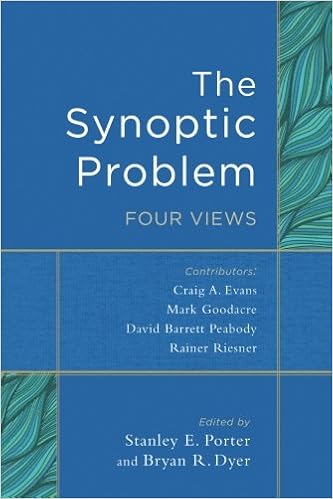
Stanley Porter and Bryan Dyer have edited a nice volume called The Synoptic Problem: Four Views that looks at four ways of explaining the relationship between the these three Gospels. I should note that I have studied under both Craig Evans and Stanley Porter (I even co-wrote a book with Stan).
The basic questions that are addressed revolve around the order in which the Gospels were written and the specific relationship between Matthew and Luke.
Craig Evans presents what is the majority opinion among New Testament scholars today. This is called the Two Source Hypothesis (also called the Four Source Hypothesis). This theory argues that Mark was written first and that it was used as a source by Matthew and Luke. The material that is common between Matthew and Luke but absent from Mark is posited as coming from a hypothetical source called Q. Thus the two sources are Mark and Q. When this theory is called the Four Source Hypothesis, it is from Mark, Q and the material unique to Matthew (M) and unique to Luke (L).
A theory that I have been eager to learn more about is the Farrer Hypothesis, a theory that has breathed new life through the work of Mark Goodacre. This theory shares with the previous hypothesis the priority of Mark. Matthew and Luke used Mark as a source. However, where it departs is when it comes to Q. Instead of having a hypothetical document, this theory argues that Luke used both Mark and Matthew as sources.
One that I was not as familiar is the Two Gospel Hypothesis. This theory, as described by David Barrett Peabody, rejects the idea of Markan priority and Q. This theory accepts the early Christian belief that Matthew was written first. Then Luke used Matthew as a source and finally Mark used both Matthew and Luke as sources. Thus the two Gospels for this theory are Matthew and Luke, since Mark is only a conflation of the two.
The final view is significantly different. The Orality and Memory Hypothesis is offered by Rainer Reisner. This theory argues that the relationships between the Gospels can be explained by their use of oral traditions. This theory is the most difficult of the four summarize but it does have some interesting ideas.
I went into this book with reasonable confidence in the Two Source Hypothesis and I do believe Evans does a masterful job of presenting it. But my confidence was shaken after reading this book. Goodacre presents a simpler view that dispenses with Q but still explains the relationships. While Mark looks like the earliest Gospel to me, Peabody’s theory has support from early Christian tradition. Finally, Reisner’s work on the oral traditions needs to be taken into account.
I really appreciated this The Synoptic Problem: Four Views, including the respectful tone used by the authors when interacting with each other. This is a valuable resource and I intend to use it as a text in a future course I will be teaching.