
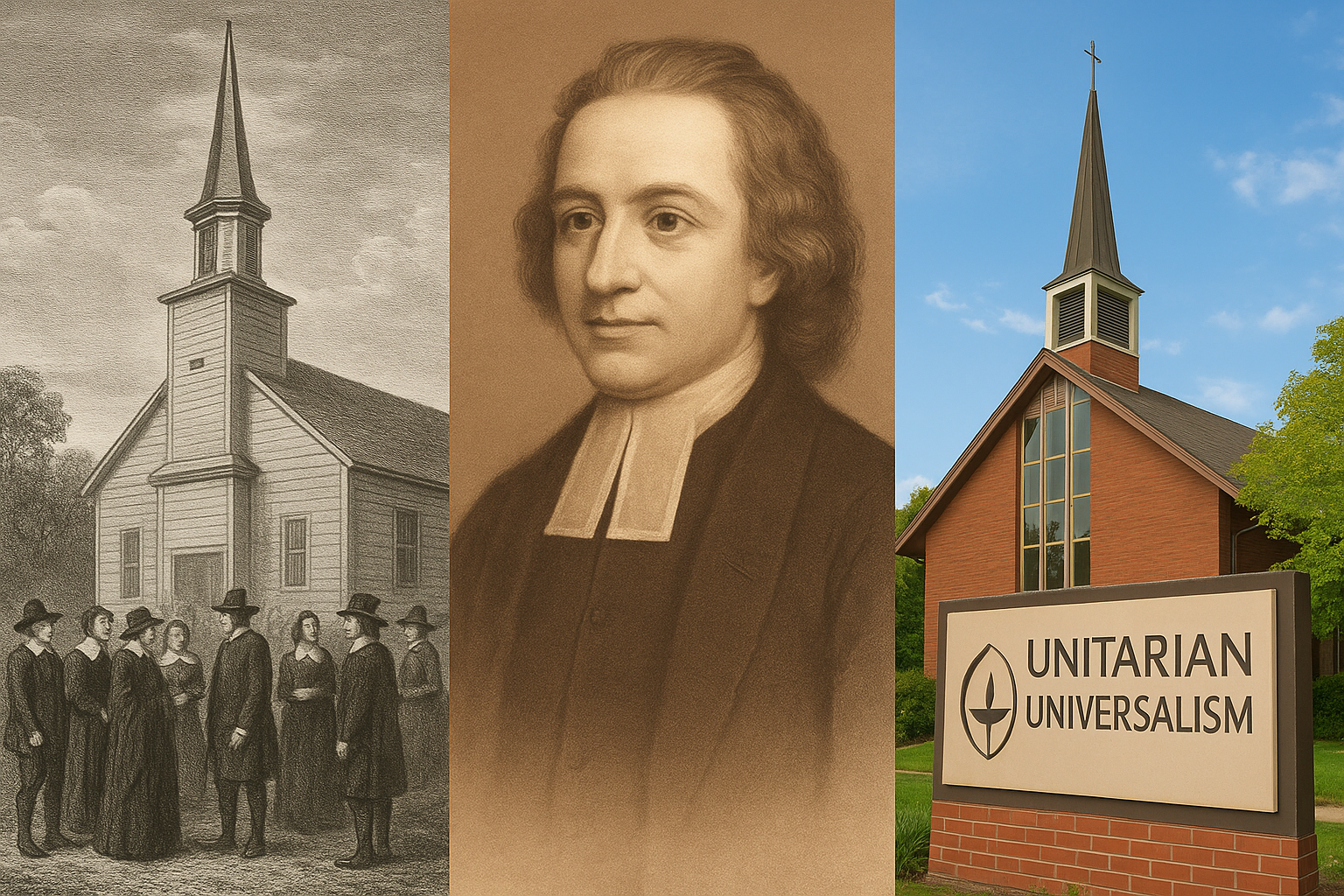
The story of how some Puritans evolved into Unitarians is one of the most fascinating transformations in religious history. What began as a movement seeking to purify the Church of England of Catholic influences eventually gave rise to one of the most liberal and rational forms of Christianity. This journey—from the rigid orthodoxy of Puritanism to the intellectual openness of Unitarianism—reflects profound shifts in theology, culture, and society over several centuries.
The Puritan Background
The Puritans emerged in England during the late 16th century as part of the broader Protestant Reformation. They were devout Calvinists who believed the Church of England had not gone far enough in separating from Roman Catholicism. Puritans sought to “purify” the church by eliminating elaborate rituals, hierarchical structures, and anything not explicitly rooted in Scripture.
Many Puritans faced persecution under English monarchs and migrated to the New World, where they founded colonies—most famously the Massachusetts Bay Colony in 1630—intended to be “a city upon a hill,” a model Christian commonwealth.
Some of the key Puritan thinkers and leaders included:
- John Winthrop – Governor of the Massachusetts Bay Colony and author of A Model of Christian Charity
- Richard Baxter – English theologian and author of The Reformed Pastor
- Thomas Hooker – Founder of the Connecticut Colony and early advocate of democracy
- John Owen – Leading Puritan theologian known for his writings on salvation and divine sovereignty
- Increase and Cotton Mather – Influential Boston ministers who defended orthodox Calvinism
Questioning the Trinity: The Seeds of Change
By the late 17th century, Puritan orthodoxy began to loosen in both England and New England. Several forces contributed to this shift. The Age of Enlightenment encouraged reason, science, and individual conscience, challenging traditional religious authority. The wars of religion in Europe made many intellectuals wary of dogmatic rigidity. The rise of scientific inquiry, through thinkers like Isaac Newton and John Locke, promoted a worldview that valued empirical evidence and rational thought.
Within this climate, some Puritan descendants—especially in more educated and urban settings—began to question Calvinist doctrines like predestination and even the Trinity. These early doubts were often quiet and cautious but would soon lead to open theological dissent.
In England, Theophilus Lindsey, Joseph Priestley, and Thomas Belsham emerged as leading figures in this transition. Lindsey, a former Anglican, established the first openly Unitarian congregation in London in 1774. Priestley, both scientist and theologian, denied Christ’s divinity but saw him as a moral and spiritual guide for humanity.
The American Transformation
In colonial New England, Puritan churches had evolved into Congregationalist bodies. Over time, exposure to Enlightenment thinking, increased literacy, and the influence of rational philosophy at institutions like Harvard College began to soften the rigid Calvinist framework.
By the late 18th century, ministers such as James Freeman, Charles Chauncy, and William Ellery Channing openly questioned the Trinity and original sin. Channing’s famous 1819 sermon, Unitarian Christianity, declared that reason and conscience must guide faith, not creeds or inherited dogma.
Theological divisions deepened between the “liberal” and “orthodox” Congregationalists. Eventually, the liberals separated, forming what became known as the American Unitarian movement. In 1825, they founded the American Unitarian Association—marking the formal split from their Puritan forebears.
Timeline: From Puritans to Unitarians
| Date | Event |
|---|---|
| Late 1500s | Puritans emerge in England seeking to reform the Church of England. |
| 1630 | Puritans establish the Massachusetts Bay Colony as a “city upon a hill.” |
| 1600s–1700s | Puritanism evolves into Congregationalism; Enlightenment ideas begin to challenge Calvinist orthodoxy. |
| 1774 | Theophilus Lindsey founds the first Unitarian congregation in London. |
| Late 1700s | Harvard and New England clergy begin questioning the Trinity and Calvinism. |
| 1819 | William Ellery Channing delivers Unitarian Christianity, defining American Unitarian belief. |
| 1825 | American Unitarian Association is founded, separating from orthodox Congregationalists. |
| 1961 | Unitarians merge with Universalists to form the Unitarian Universalist Association (UUA). |
| Today | Unitarian Universalism embraces a pluralistic, inclusive spirituality with no fixed creed. |
Cultural and Historical Forces Behind the Shift
The Puritan-to-Unitarian transformation reflected more than theology—it mirrored the intellectual and social evolution of the Western world:
- The Enlightenment encouraged critical thinking and challenged traditional authority.
- Scientific progress inspired confidence in human reason.
- Democracy and liberty in the American Revolution validated freedom of conscience.
- Religious tolerance in the new United States allowed dissenting movements to flourish.
These forces collectively made the old Puritan orthodoxy seem restrictive, while Unitarianism offered a faith compatible with modern thought.
From Unitarianism to the Present
In the 19th century, Unitarianism became synonymous with liberal Christianity and social reform. Unitarians were prominent in the abolitionist, women’s rights, and education movements. They emphasized character, reason, and moral action over creedal conformity.
By the 20th century, many Unitarians broadened their theology beyond Christianity, embracing humanism and religious pluralism. The 1961 merger with the Universalist Church of America formed the Unitarian Universalist Association (UUA)—a body with no creed but a shared commitment to human dignity, justice, and truth-seeking.
Today, Unitarian Universalists draw inspiration from many traditions, including Christianity, Buddhism, and earth-centered spirituality. What began as an effort to purify the Church of England has become one of the most open and inclusive faith movements in existence.
Conclusion
The evolution from Puritanism to Unitarianism tells the story of how faith adapts to reason, culture, and conscience. The Puritans sought to purify the church; the Unitarians sought to purify belief itself—transforming a strict theology of fear and obedience into a religion of freedom and compassion. From “a city upon a hill” to a community of seekers, the journey reflects the enduring human quest for truth and integrity in faith.